
RUBIO’S OLD MANILA IS JOAQUIN’S 5TH ANNIVERSARY SHOW
Opens Tuesday, 13 November 2007
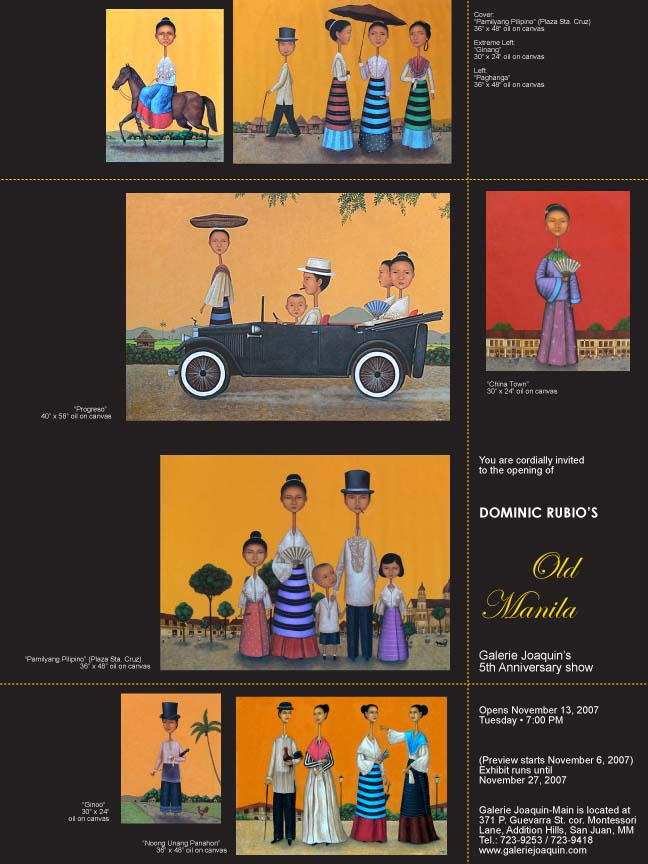
In celebration of its 5th anniversary, Galerie Joaquin Main presents Dominic Rubio’s Old Manila, an exhibition of works by Dominic Rubio inspired by the Philippines during the latter part of the Spanish colonial era (1850-1896) and the early American colonial period (1900 –1930).
In the show which opens November 13 and runs till November 26, 2007, Rubio’s concern is to capture the nostalgia and romanticism of these periods while giving them a modern sensibility and whimsical appeal.
Galerie Joaquin Main is located at 371 P. Guevarra Street , corner Montessori Lane , Addition Hills, San Juan , (tel. 7239253 or 7239418). For more information, please visit www.galeriejoaquin.com
For Old Manila, Rubio, who turns 37 this year will be presenting 37 oil on canvas works. These include Malacanang by the River, Progreso, Bagumbayan ( Luneta Park ), Binondo Arcade (Promenade in Chinatown), Ginoo (Gentleman), Ginang (Lady), Man and Woman in Old Chinatown (diptych), To the Market, Plaza Sto. Tomas and Noong Unang Panahon V (Early Times V).
A founding member of the Guevarra Group and a graduate of the University of Sto Tomas ’ College of Fine Arts , Rubio has been painting for almost two decades. It was Rubio who was featured in Balik Alaala (remembering the Past) the inaugural exhibit when Galerie Joaquin Main first opened its doors in 2003. It was also Rubio’s show Early Times (Noong Unang Panahon) that became the inaugural exhibit when Galerie Joaquin Singapore opened at The Regent of Singapore.
Rubio has been inspired to paint the men and women at the turn-of the century depicting faces and figures from the same period and milieu, quintessential symbols of innocence and naivete at a time of great socio-political change. Challenged by the possibilities of these subjects, Rubio has developed a new and highly contemporary style.
In Old Manila, city folk found great pleasure in patronizing performing arts such as the theater, the komedya, the zarzuela and going to exhibitions. Other times they would be visiting parks and gardens in particular the Luneta, Manila ’s major park fronting its historic bay with the romantic sunset. The Binondo Arcade, or the sprawling grounds near the University of Sto . Tomas (Plaza Sto. Tomas). Many families (Pamilyang Pilipino) and couples as well enjoyed the almost ritualistic paseo where one would promenade in all their finery (Malacañang by the River) and (Ginang). Other pastimes or forms of leisure included the cockfight or the sabong (Tatlong Sabungero). Sundays were special occasions when the gentleman of the house would bring his favorite fighting cock to the cockfight and lady of the house prepared to go for religious services both dressed in their Sunday best (Ginoo) and (Ginang). As the Philippines became a major exporter of tobacco with Philippine cigars enjoying equivalent prestige in Europe as their Cuban counterparts, both men and women learned how to enjoy a good puff.
Intermarraiges occurred resulting in the mestiza whether Spanish –Filipino or Chinese-Filipino. Wealth was accumulated by the compradors who handled the export trade via the government supervised export-import monopoly of The Galleon Trade between Manila and Mexico . The high-heeled gentry from the comprador group as well as the landlords who owned the large agricultural plantations came to be known as the “Señor” and “Señora”. Domestic trade and commerce continued through the work of women vendors who peddled milk, puto (rice cakes), mats (banig), vegetables (such as Sitaw) or jars while tradesmen and craftsmen such as the barbero, the coconut and abaca trader, the bread manufacturer (Panaderia) or the basket maker remained mostly with the Chinese.
Such is the mystical world of Dominic Rubio. Relying on past themes he has succeeded in interpreting them in a highly contemporary style that has become so very popular in today’s art scene. His subjects with long craning necks suggest no less than a people with much to be proud of thanks to their rich culture and heritage.

