
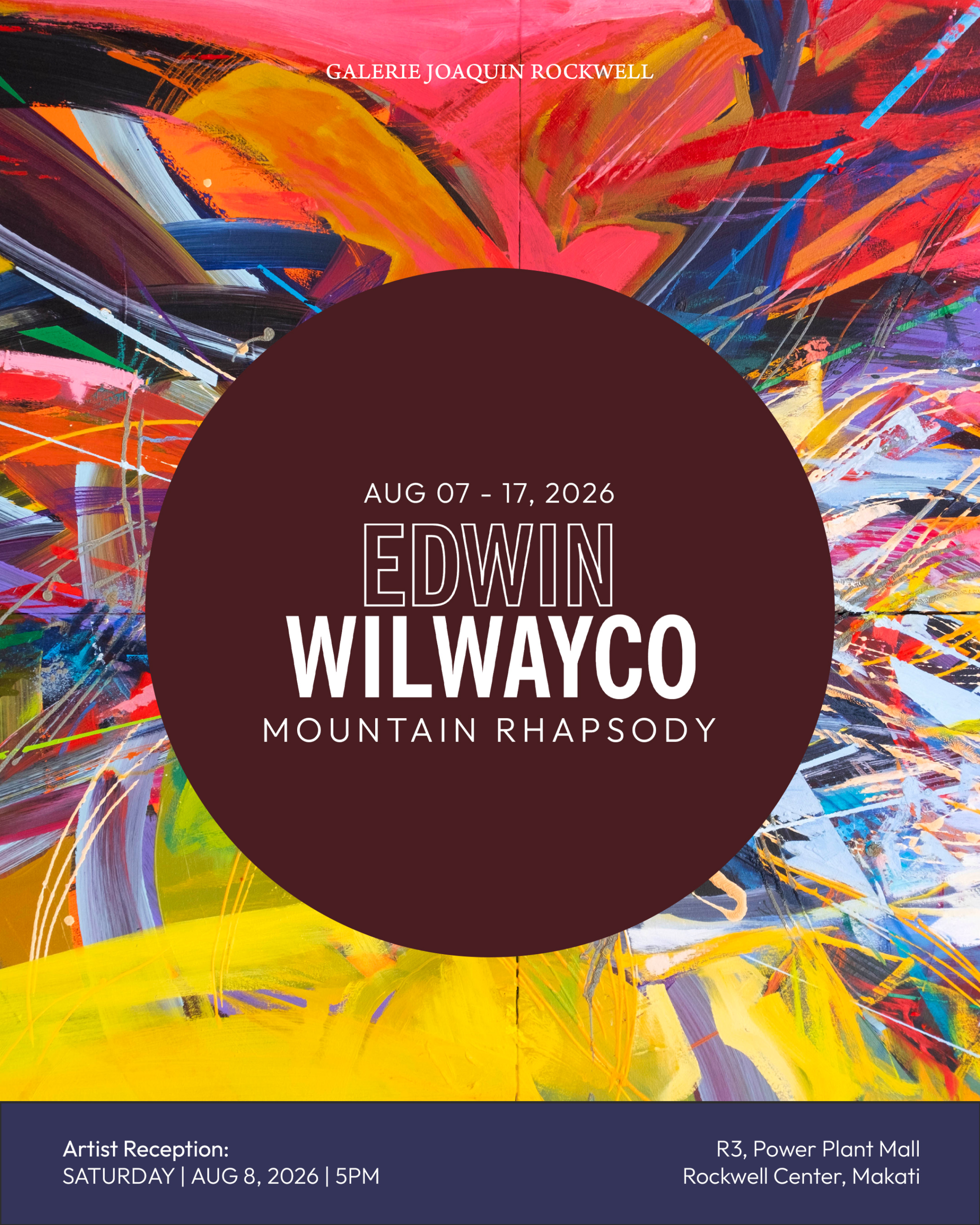
“Mountain Rhapsody” by Edwin Wilwayco
Galerie Joaquin Rockwell
August 07 – 17, 2026
EDWIN WILWAYCO’S “MOUNTAIN RHAPSODY”: FOREVER ASCENDING
By CID REYES
Beyond the image of man himself, there stands another sovereign subject in art: Nature, that ancient and inexhaustible mystery from which humanity has drawn both fear and wonder. Long before cities rose, before kingdoms carved their names upon stone, man gazed upon the world around him and sought to decipher its immensities. The earth beneath his feet, the fire that consumed and renewed, the air that moved unseen, and the waters that nourished and destroyed—these elemental powers became his first teachers, his first gods, and his first enigmas.
Across the centuries, artists have continued this conversation with Nature. They have painted seas convulsed by storms, forests consumed by fire, and mountains shattered by volcanic fury. Such visions remind us of a truth civilization often forgets: that despite all our triumphs, we remain small before the vast energies of creation. Out of this confrontation emerged one of humanity’s most profound ideas—the Sublime.
The Sublime is that moment when beauty becomes so immense that it overwhelms reason. It is the sensation of standing before a raging ocean, a thunderous storm, or a mountain whose summit vanishes into the clouds. One feels at once exalted and diminished, thrilled and terrified. Wonder mingles with vulnerability. The soul recognizes a grandeur beyond measure.
This experience is not merely aesthetic; it is spiritual. In the Scriptures, mountains and hills appear more than five hundred times, serving as sacred thresholds between heaven and earth. They are places of revelation and covenant, symbols of divine majesty, steadfast faith, and the eternal presence of God. The mountain rises not only from the landscape but from the human imagination as a sign of transcendence.
It is, therefore, no surprise that some of the greatest artists have found in the mountains an inexhaustible source of meaning. Among them, none is more celebrated than the French Post-Impressionist Paul Cézanne. Throughout his life, he returned again and again to Mount Sainte-Victoire in Provence, painting it from his window and from countless vantage points. Yet Cézanne was not merely recording a landscape. He was wrestling with Nature itself, seeking to transform its shifting forms into enduring structures of color, geometry, and light. The mountain became his lifelong dialogue with permanence and change, reality and perception.
Closer to home, in this archipelago forever haunted by volcanoes and storms, the Mountain comes at last to Edwin Wilwayco.
One thinks of mountains as ancient presences: solemn, immovable, enthroned above the restlessness of men. Yet in Wilwayco’s hands, the mountain is stripped of its silence. It ceases to be scenery. It becomes an event.
Among the practitioners of Philippine Abstract Expressionism, Wilwayco stands as one of its most formidable survivors and celebrants. In his youth at the University of the Philippines, he came under the spell of Jose Joya, that high priest of gestural painting whose canvases transformed color into movement and paint into pure velocity. Joya’s art embodied the energies of action painting, where the sweep of the arm, the thrust of the body, and the rhythm of instinct became as important as the image itself.
The lesson was not lost on the young Wilwayco. For nearly half a century, he has remained faithful to the conviction that painting is not merely the arrangement of forms upon a surface but an encounter between matter and spirit. His canvases are arenas where gesture contends with resistance, where pigment wrestles with space, where accident and intention engage in their ancient duel.
Through the years, he has sought his subjects not in narrative but in sensation. Music stirred him into chromatic rapture; liturgical prayers opened passages toward contemplation; rivers, winds, and seas became occasions for meditations on movement itself. Again and again, he returned to nature, not as a recorder of appearances but as a seeker of forces hidden beneath appearances.
Now he turns to the mountain.
But Wilwayco is no pilgrim gazing upward from the valley. Unlike Paul Cézanne, who contemplated Mont Sainte-Victoire with reverence from a distance and transformed it into a monument of structure and permanence, Wilwayco enters the mountain as one enters a tempest. He confronts it not as an object but as a living upheaval. Beneath his strokes, one senses the grinding of tectonic plates, the surge of subterranean fire, the immense pressures that wrinkle continents and thrust stone toward the heavens. The mountain is not geology alone; it is creation still in progress.
What emerges on the canvas is therefore not a portrait of a mountain but the drama of becoming. Color erupts, collides, and settles into temporary harmonies. Forms rise and dissolve. The eye is carried across the surface much as wind travels across a ridge or water courses through a ravine.
In this, the artist fulfills the celebrated injunction of the French poet Stéphane Mallarmé: not to paint the thing itself, but the effect it produces. The mountain before him is transformed into the mountain within him. What the viewer encounters is not landscape but experience—nature translated into feeling, matter transfigured into energy, and the visible world reborn as sensation.
For Edwin Wilwayco, the mountain is less a place than a state of being: immense, restless, and forever ascending.
Mountain Rhapsody by Edwin Wilwayco will be on view from August 7-17, 2026 at Galerie Joaquin Rockwell with an Artist Reception on August 8 at 5 p.m. The gallery is located at the R3 Level, Power Plant Mall, Rockwell Center, Makati City. For inquiries, contact Galerie Joaquin at +63 915 414 5502 or email galeriejoaquinrockwell@gmail.com

Acrylic and Oil on Canvas

Acrylic and Oil on Canvas

Acrylic and Oil on Canvas

Acrylic and Oil on Canvas

Acrylic and Oil on Canvas

Acrylic and Oil on Canvas

Acrylic and Oil on Canvas

Acrylic and Oil on Canvas

Acrylic and Oil on Canvas

Acrylic and Oil on Canvas

Acrylic and Oil on Canvas

Acrylic and Oil on Canvas

Acrylic and Oil on Canvas

Acrylic and Oil on Canvas

Acrylic and Oil on Canvas

Acrylic and Oil on Canvas

Acrylic and Oil on Canvas

Acrylic and Oil on Canvas

Acrylic and Oil on Canvas

Acrylic and Oil on Canvas

Acrylic and Oil on Canvas

Acrylic and Oil on Canvas

Acrylic and Oil on Canvas

Acrylic and Oil on Canvas

Acrylic and Oil on Canvas

Acrylic and Oil on Canvas

Acrylic and Oil on Canvas

Acrylic and Oil on Canvas

Acrylic and Oil on Canvas

Acrylic and Oil on Canvas

Acrylic and Oil on Canvas

Acrylic and Oil on Canvas

Acrylic and Oil on Canvas


Acrylic on Canvas

Acrylic on Canvas

Acrylic on Canvas

