
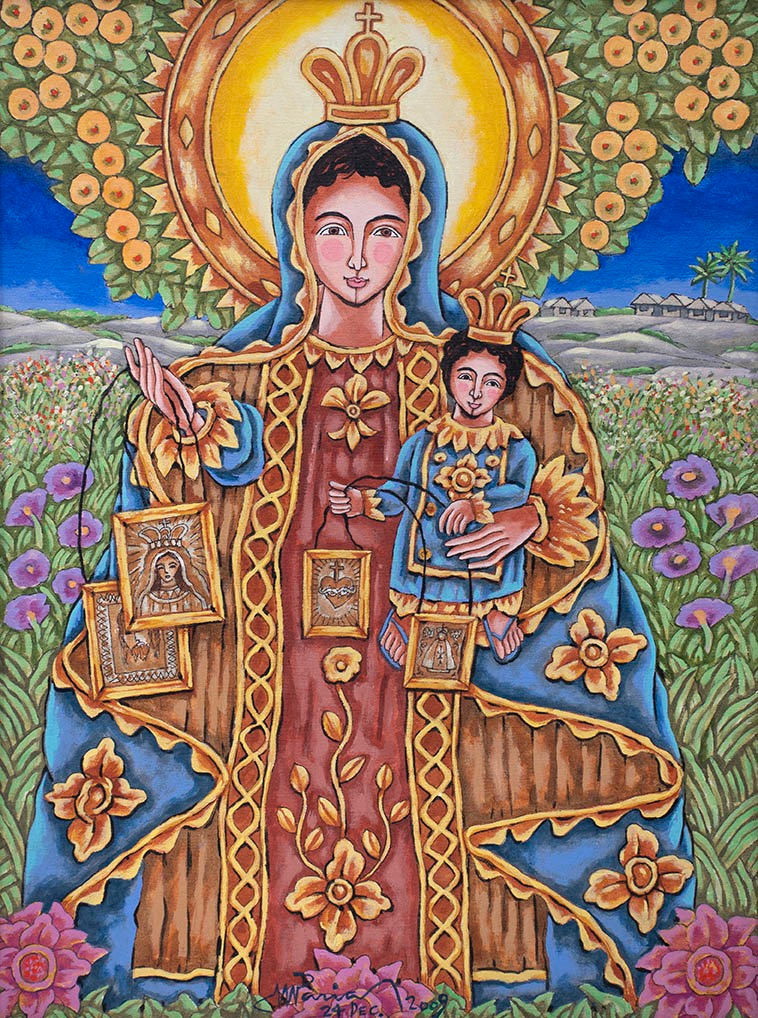
Mario Parial, perhaps best-known today for his festive canvas works, was, in fact, one of the most experimental of that lauded generation of artists. His paintings, as well as his works of print and photography, are pioneering in their depictions of folk religious imagery, rural landscape themes, and infectious joie de vivre in palette, hue and tone.
The works of eminent painter and Thirteen Artists Awardee Mario Parial have long been characterized by lively exuberance. The fantasy worlds of color and life that he brings out in his paintings have made him one of the most sought-after artists in the country. His reputation as a maverick in the art scene has seen him creating works that are as lively today as when he started his practice in the 60s.
Parial finds new meaning in the familiar archetypes and motifs of his practice such as the jester-musician, the flower-laden maiden, the blooms of summer, and the songs of angels. This celebration of enthusiasm and beauty – this call to joy – brings positivity and optimism to a Parial piece, and no doubt lends credence to his reputation as a top painter. This quiet celebration of life is a fascinating direction for the senior painter, and his paintings are purposefully filled with subjects of joy.
Over four decades of experience as one of the foremost genre painters has enabled Mario Parial to demonstrate a balance of technique and vision almost unparalleled in today’s art scene. With dozens of one-man shows to his name, including exhibitions in the US, Canada, Germany, Hong Kong, Taiwan, and Singapore, the University of Santo Tomas-trained Parial is recognized as one of the leading painters in the country today. A multi-awarded artist, Parial is one of the earliest winners of the Thirteen Artists Award of the Cultural Center of the Philippines, winning it in 1972. His works are included in many books on Philippine art, including such seminal works as “The Struggle for Philippine Art” by Purita Kalaw-Ledesma and Amadis Ma. Guerrero, and “Filipino Nudes” by Alfredo Roces.