
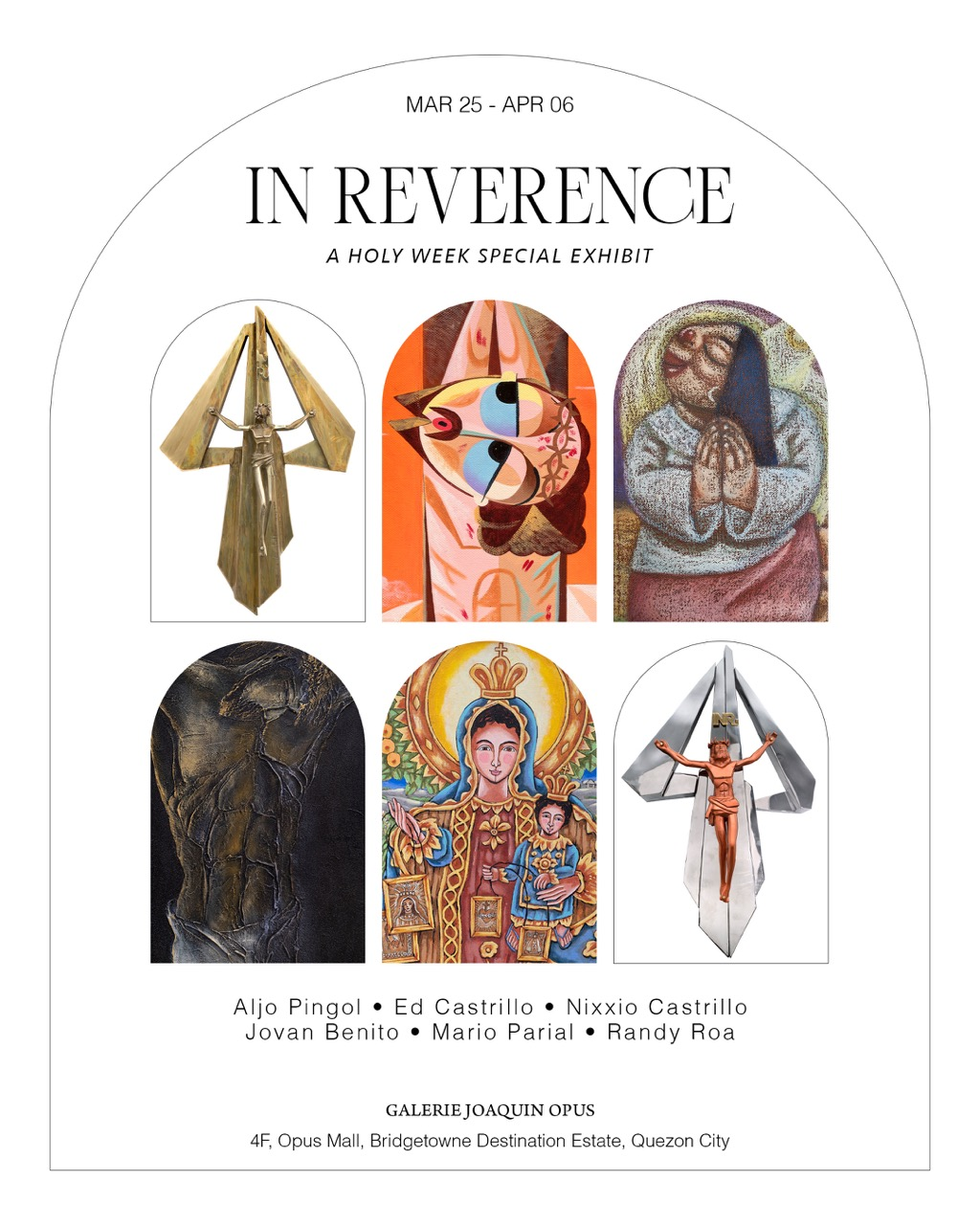
“In Reverence A Holy Week Special Exhibit ”
Galerie Joaquin Opus
March 25 – April 06, 2026
In Reverence” assembles a collection of works that articulate the sacred through a disciplined interplay of form, material, and iconography. This exhibition draws from a lineage of devotional imagery deeply embedded within Philippine visual culture, yet it reframes this inheritance through a contemporary sensitivity to structure, surface, and affect. What emerges is not a reiteration of doctrine, but a recalibration of attention—where the sacred is encountered through stillness, reduction, and the withholding of excess.
The selected works traverse multiple formal languages while remaining anchored in shared theological and emotional registers. In Benito’s vividly orchestrated composition of the washing of the feet, clustered figures bend and converge in a choreography of humility, their stylized physiognomies emphasizing gesture over individual identity. Castrillo’s crucifixes are rearticulated through sculptural abstraction: fractured planes of metal intersect to form a cross that is at once architectural and corporeal, suspending the figure of Christ within a field of tension between weight and ascension. These works resist singular readings, instead proposing the sacred as something continually reconstituted through material and form.
Meanwhile, a parallel thread of introspection unfolds in the treatment of sorrow and witness. In Mario Parial’s image of Veronica, the artist presents the veil not only as a relic but as a site of imprint—where repetition and multiplicity evoke both the diffusion and persistence of suffering. In another register, the crucified body is rendered through dense, seemingly tactile surfaces that verge on dissolution, the figure emerging from and receding into darkness. Here, materiality assumes a near-theological function: texture, patina, and tonal restraint articulate a condition of endurance that exceeds narrative, situating the body within a continuum of fragility and transcendence.
In Reverence ultimately advances a mode of looking that approaches the contemplative as method. The exhibition does not seek to resolve the tensions it presents; rather, it sustains them, allowing meaning to unfold through duration and attentiveness. In this space, the sacred is neither distant nor declarative. It resides instead in the persistence of form, in the gravity of material, and in the act of sustained regard itself.
Artworks

Mixed Media on Canvas

Mixed Media on Canvas

Fumage on Board

Fumage on Board

Fumage on Board

Mixed Metals

Acrylic on Canvas

Acrylic on Canvas

Brass

Brass

Brass

Brass

Acrylic on Canvas

Acrylic on Canvas

Oil on Canvas

Oil on Canvas

Oil on Canvas

