
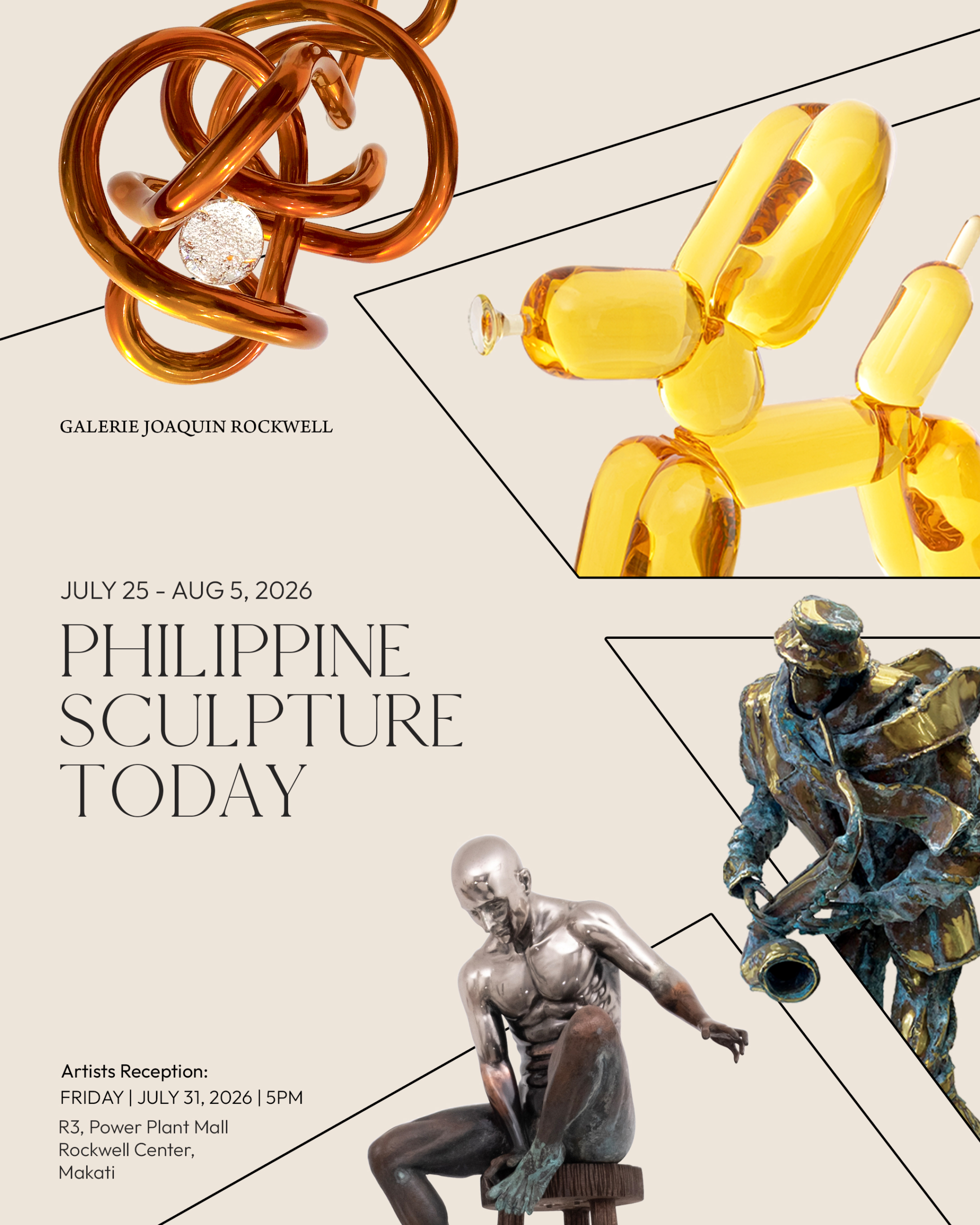
“Philippine Sculpture Today”
Galerie Joaquin Rockwell
July 25 – August 5, 2026
There is a wry observation attributed to the American abstractionist Ad Reinhardt: “Sculpture is something you bump into when you back up to look at a painting.” The remark has endured because it exposes a long-standing prejudice within the visual arts. It pokes fun at the museum-goer who walks straight toward a painting, only becoming aware of a sculpture after literally colliding with it. Amusing as it is, the quip reveals how sculpture has often occupied a secondary place in public consciousness.
History tells a different story. Sculpture has rarely been a mere companion to painting. From antiquity onward, it has stood at the center of civic and spiritual life. Monuments proclaimed the authority of rulers, religious images embodied the power of faith, and memorials shaped collective memory. Unlike paintings, which often remained within palaces or museums, sculpture confronted the public in plazas, churches, parks, and streets. It has always spoken with the authority of permanence.
The rivalry between painting and sculpture reached its most celebrated expression during the Italian Renaissance in the Paragone, the comparison of the arts. Leonardo da Vinci championed painting as the noblest artistic pursuit, arguing that it demanded intellectual invention and mastery of illusion, while sculpture depended upon strenuous manual labor. He famously described the sculptor as covered with marble dust “like a baker,” in contrast to the painter, elegantly dressed and working in comfort before the easel.
History, however, refused to declare a victor. Michelangelo’s David became one of civilization’s greatest sculptural achievements, while Leonardo’s paintings remain among humanity’s highest artistic accomplishments. Their disagreement ultimately enriched both disciplines, demonstrating that painting and sculpture continually challenged and strengthened one another.
ON THE MARGINS
In the Philippines, sculpture occupied the margins of artistic discourse. While painting, literature, music, architecture, dance, theater, and later cinema commanded public attention, sculpture remained largely confined to devotional santos and commemorative monuments. Worthy as these traditions were, they also reflected a medium whose possibilities had yet to be fully explored.
The evolution of Philippine sculpture parallels developments in the West. Auguste Rodin transformed nineteenth-century sculpture while remaining rooted in academic training. Yet his apprentice Constantin Brancusi understood that true artistic independence required breaking away from inherited conventions. “Nothing grows under large trees,” Brancusi remarked as he abandoned Rodin’s expressive realism in favor of direct carving and radical simplification.
A similar turning point occurred in Philippine art. Guillermo Tolentino, celebrated for the University of the Philippines Oblation and the Bonifacio Monument, established the country’s classical sculptural tradition. His student, Napoleon Abueva, mastered academic discipline before forging an entirely new language. Rejecting descriptive realism, Abueva embraced simplification, direct carving, and essential form, opening the path toward modern Philippine sculpture.
EXPRESSION IN THREE DIMENSIONS
Among those who extended sculpture’s possibilities was National Artist Arturo Luz. Already renowned as a painter, he occupied a singular position in the 1970s, simultaneously directing Luz Gallery, the Design Center Philippines, and the Museum of Philippine Art. Yet administration never diminished his search for formal purity.
Luz’s paintings had long been distilled to disciplined lines and geometric order. It was only natural that this vocabulary should eventually seek expression in three dimensions. Working in wood, concrete, and iron, he translated the elegance and restraint of his paintings into sculptural constructions whose quiet balance reflected the same uncompromising aesthetic. When the Metropolitan Museum presented his retrospective in 1990, the sculptures appeared not as departures but as the logical extension of his lifelong pursuit of essential form.
LABOR, EXPERTISE, MATERIAL
Luz was candid in explaining why sculpture struggled to flourish in the Philippines. The obstacles were both practical and cultural. Sculpture demanded physical labor, technical expertise, and expensive materials far beyond the requirements of painting. More importantly, he believed that the Filipino public had never fully learned how to see sculpture. Accustomed to the pleasures of color and pictorial illusion, viewers often overlooked sculpture’s language of mass, volume, rhythm, and space. The deficiency, he argued, lay not in the medium itself but in visual education.
A DRAMATIC CHANGE
Today that situation has changed dramatically. Philippine sculpture has emerged with renewed vitality, expanding beyond carving and casting into an arena of experimentation and invention. Contemporary sculptors embrace industrial materials, found objects, glass, steel, resin, and mixed media, exploring ideas that transcend conventional definitions of the medium. Sculpture is no longer confined to monuments or religious images. It has become a site of cultural inquiry, conceptual exploration, and formal innovation.
The exhibition Philippine Sculpture Today, presented by Galerie Joaquin, affirms that Philippine sculpture stands at the threshold of a genuine renaissance. Alongside established masters such as Eduardo Castrillo, Ramon Orlina, and Julie Lluch, a younger generation reshapes the language of three-dimensional art through new materials, unconventional processes, and contemporary ideas. Their works dissolve traditional boundaries while remaining grounded in the sculptural concerns of form, space, and material.
Ad Reinhardt’s celebrated quip may still provoke a smile. Yet it no longer describes the condition of sculpture today. One no longer encounters sculpture merely by accident while retreating from a painting. It has claimed its own space, its own audience, and its own authority. In contemporary Philippine art, sculpture has emerged from the shadows to become one of its most vital and compelling expressions.
Cid Reyes is one of the Philippines’ foremost art critics, authors, and artists. He is the writer chosen by five National Artists—Arturo Luz, BenCab, J. Elizalde Navarro, Napoleon Abueva, and Fernando Amorsolo—to document their lives and artistic achievements. A graduate of San Beda College and De La Salle University, he pursued painting at the Accademia di Belle Arti in Rome and studied art history at the City Lit Institute in London.

Laminated Coldworked Glass
Anna Orlina
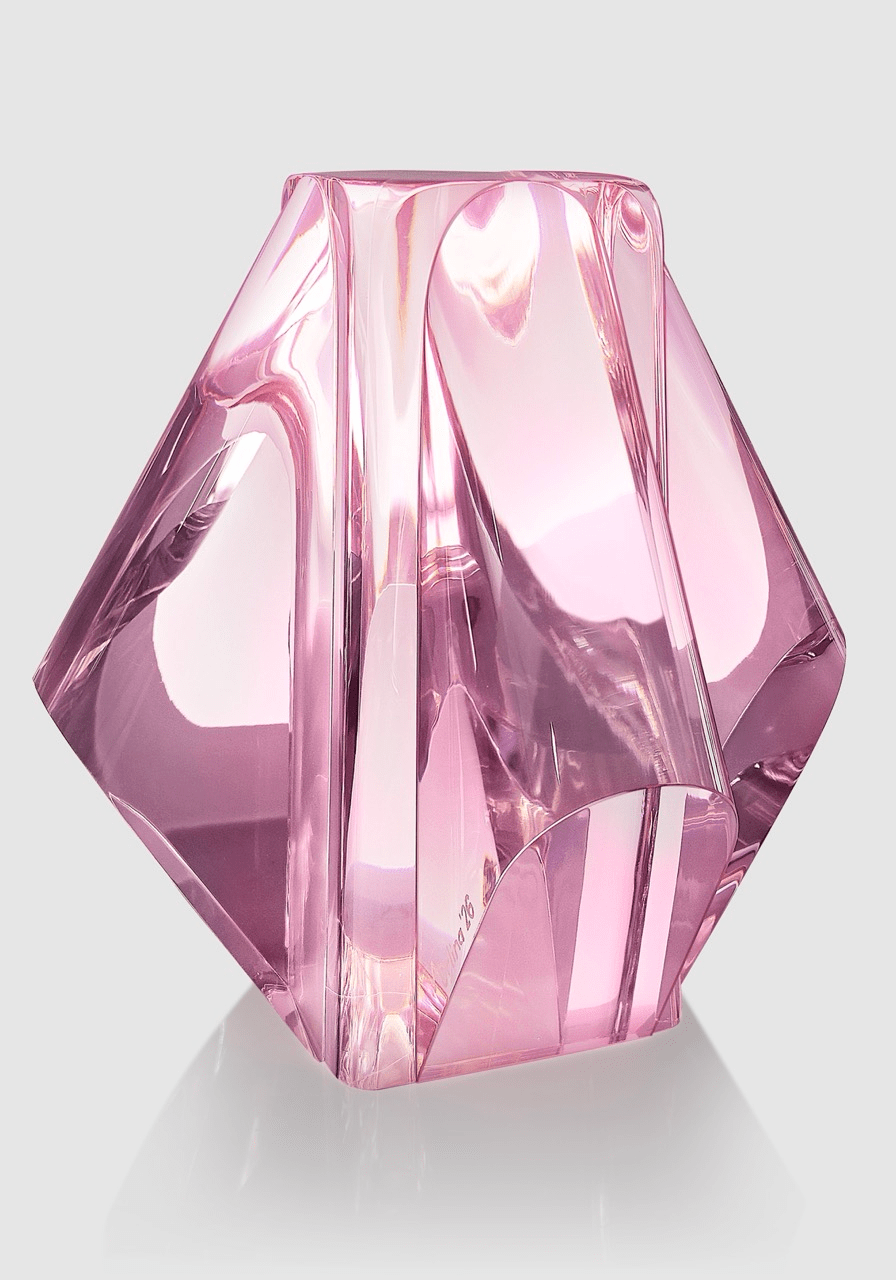
Laminated Coldworked Glass
Anna Orlina

Wood and Resin
Velda

Wood and Resin
Penaso

Stainless Steel
Penaso

Stainless Steel
Penaso

Stainless Steel
Penaso

Copper brass on steel base
Buxani

Copper brass on steel base
Buxani

Copper brass on steel base
Buxani

Mixed media
Mallari

Mixed media
Mallari

Carved Wood
Ronnel Cainto

Carved Wood
Ronnel Cainto

Carved Wood
Ronnel Cainto

Coldworked Painted Crystal
Marge Organo

Coldworked Optical Glass
Organo

Mixed Metals
Castrillo

Glass
Limaten

Glass
Limaten

Glass
Millan

Glass
Millan

Aluminum steel
Millan

Resin and fiberglass
Vicaldo

Resin and fiberglass
Vicaldo

Resin and fiberglass
Vicaldo

Resin and fiberglass
Vicaldo

Cold cast marble
Lluch

Brass
Villanueva

Brass
Villanueva

Brass
Villanueva

Brass
Hipolito

Brass
Hipolito

Brass
Hipolito

Metal and Resin
Gabito

Metal and Resin
Gabito

Fabricated Aluminum Alloy and Polymer Crystal Resin
Faico

Fabricated Aluminum Alloy and Polymer Crystal Resin
Faico

Fabricated Aluminum Alloy and Polymer Crystal Resin
Faico

Mixed Metals
Dela Cruz

Mixed Metals
Dela Cruz


Resin
Art de Leon

Resin
Art de Leon

Resin and wood
Art de Leon


Brass
AJ Manuel

Brass
AJ Manuel

Brass
AJ Manuel

Brass
AJ Manuel


